Consolidating Web Launch Workflows at Indiana University
Cut a university website launch process from 7 steps to 2 — a 71% efficiency gain — by redesigning the workflow around the people who actually run it, and used that same redesign to clear a backlog of 1,500+ outdated sites the old process could never retire.
- Role
- UX & Service Designer
- Timeframe
- June 2025 – May 2026
- Focus
- Service Design · Systems Thinking · Higher Ed
A launch at IU passed through seven separately-governed teams before anyone asked why.
Indiana University requires every department, lab, or student body that wants a website to go through its IT Services organization — hosting, a content management system, a design system, brand guidelines, and content review each had their own request, review, and approval cycle. A department head trying to launch one lab website could face seven separate hand-offs. When the process was slow enough, people quietly took their sites to outside hosting instead — which meant IU had no way to enforce its own design or brand guidelines on the result.
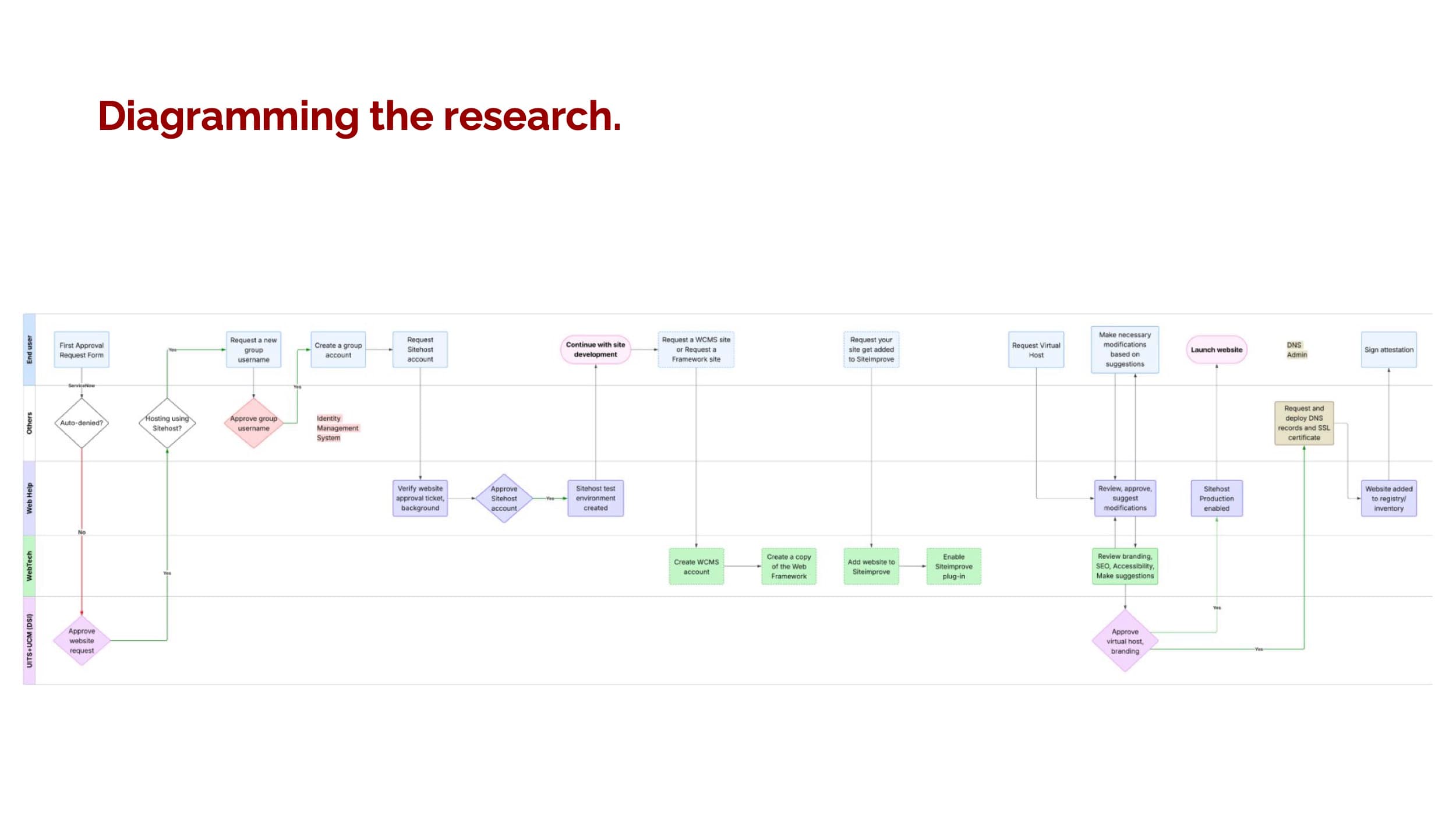
Every step was defensible on its own — together, they added weeks to work that should take days.
The approval, launch, and retirement workflow required 7 steps, creating delay and friction for the staff and departments trying to publish or retire university web content. Documentation for the entire process lived on a single, hard-to-find page, and requesters had to return to it after completing each step just to find the next one. The seven approving teams all sat inside the same university IT organization, but had no shared system for handing a case to one another — so the burden of coordinating the process fell on the person just trying to launch a website.
Cross-stakeholder process running inside ServiceNow, spanning multiple IT teams — most of it manual and email-based, with several teams bottlenecked on a single approver
Governance and accessibility requirements had to be preserved while removing friction, and campus-specific departments added their own exceptions to account for
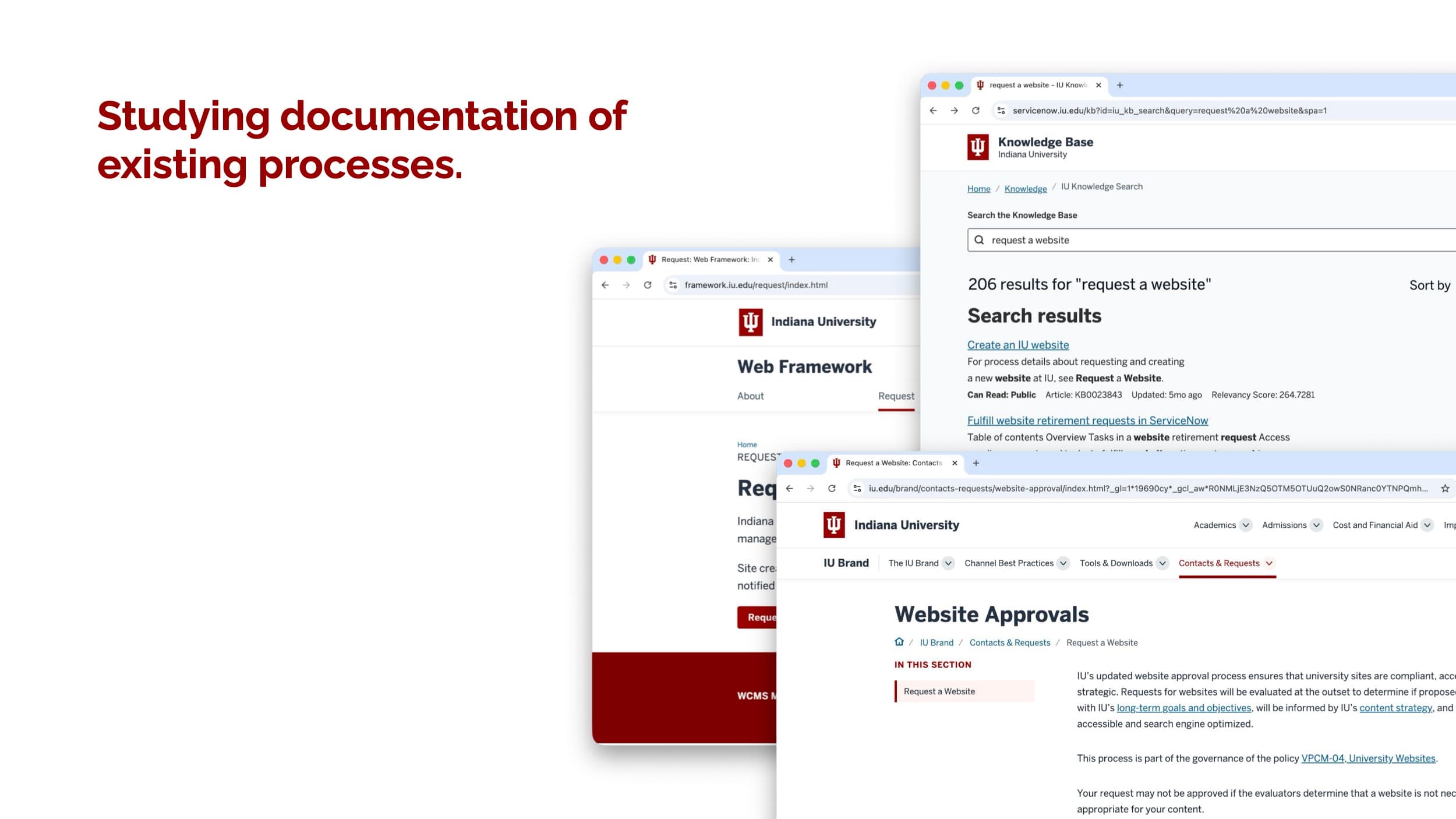
Fixing it meant mapping the workflow people actually used, then rebuilding it with them, not for them.
I sat with all seven approving teams, not just the process documentation
Interviewed stakeholders across every team in the workflow — web support, web hosting, quality control, and branding among them — to understand how requests actually moved once they landed. Most of it turned out to run on email, ad hoc delegation by whoever happened to pick it up, and in some teams, a single approver holding up everything behind them.
The vision started as one unified platform — we scoped it down to a redesigned process first
With a senior designer, redesigned the process and built high-fidelity, fully interactive prototypes on the Rivet Design System — IU's official design system — so stakeholders could click through the new workflow rather than just read about it. Sharing it widely surfaced real misalignment between what the new process assumed and how the teams actually worked, and left the bigger question of implementation still open.
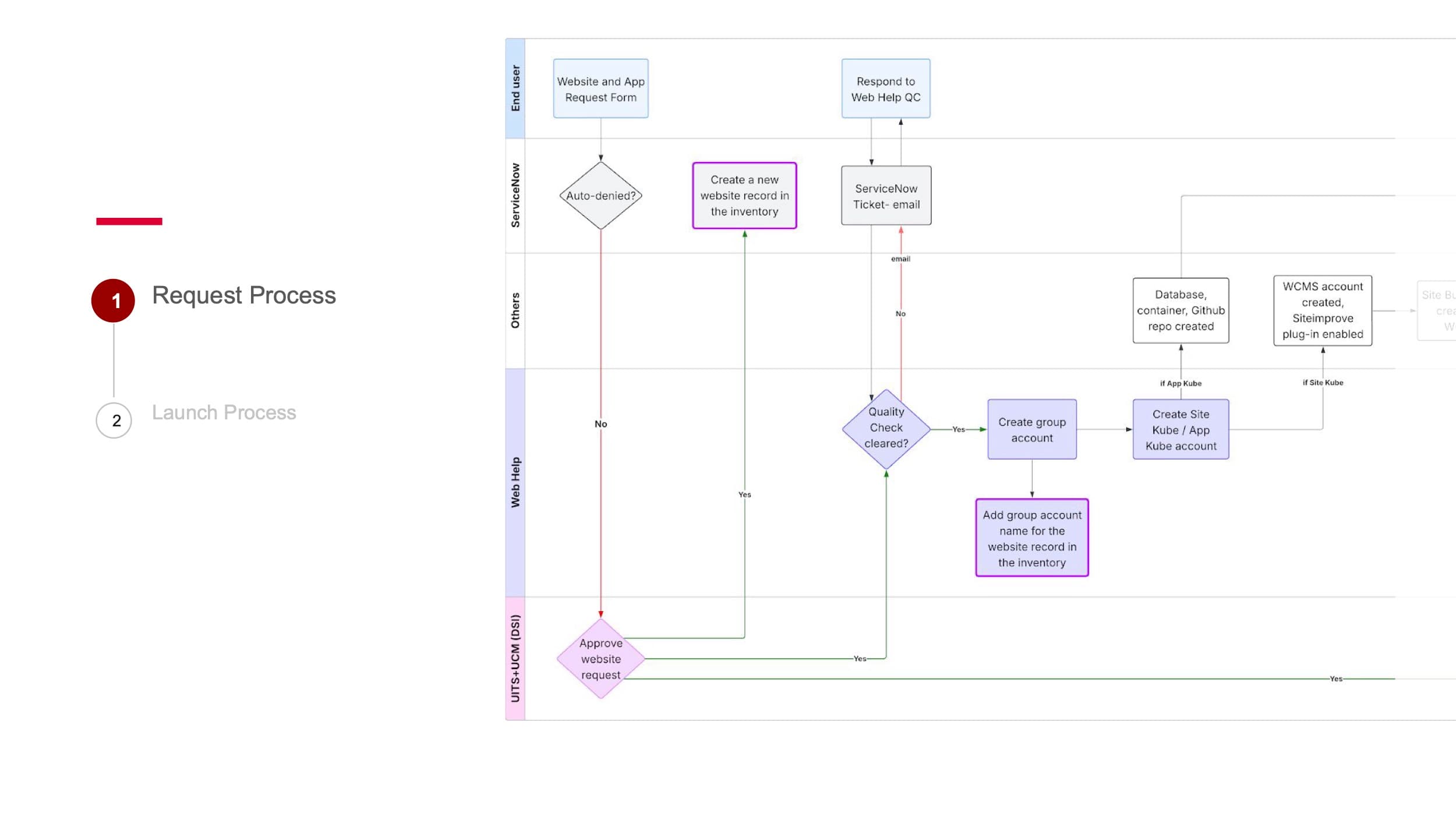
Learned ServiceNow deeply enough to build the redesign inside a tool IU already owned but underused
A parallel university initiative to get more value out of ServiceNow gave the redesign a home. I learned the platform in depth — the real distinctions between an incident, an interaction, and a request — and built the new workflow as tasks inside ServiceNow requests, rather than pushing for new software the team would have to learn from scratch.
Scoped the first release to retirement — the one step that had stayed pure email, and let 1,500+ outdated sites linger
Retirement had never been part of any structured workflow — it ran entirely over email, so outdated sites simply stayed live. We piloted the new retirement process with the help desk first, the team already handling most of the delegation and redirection, then iterated on how ServiceNow represented the data before extending the same approach to the approval and launch processes.
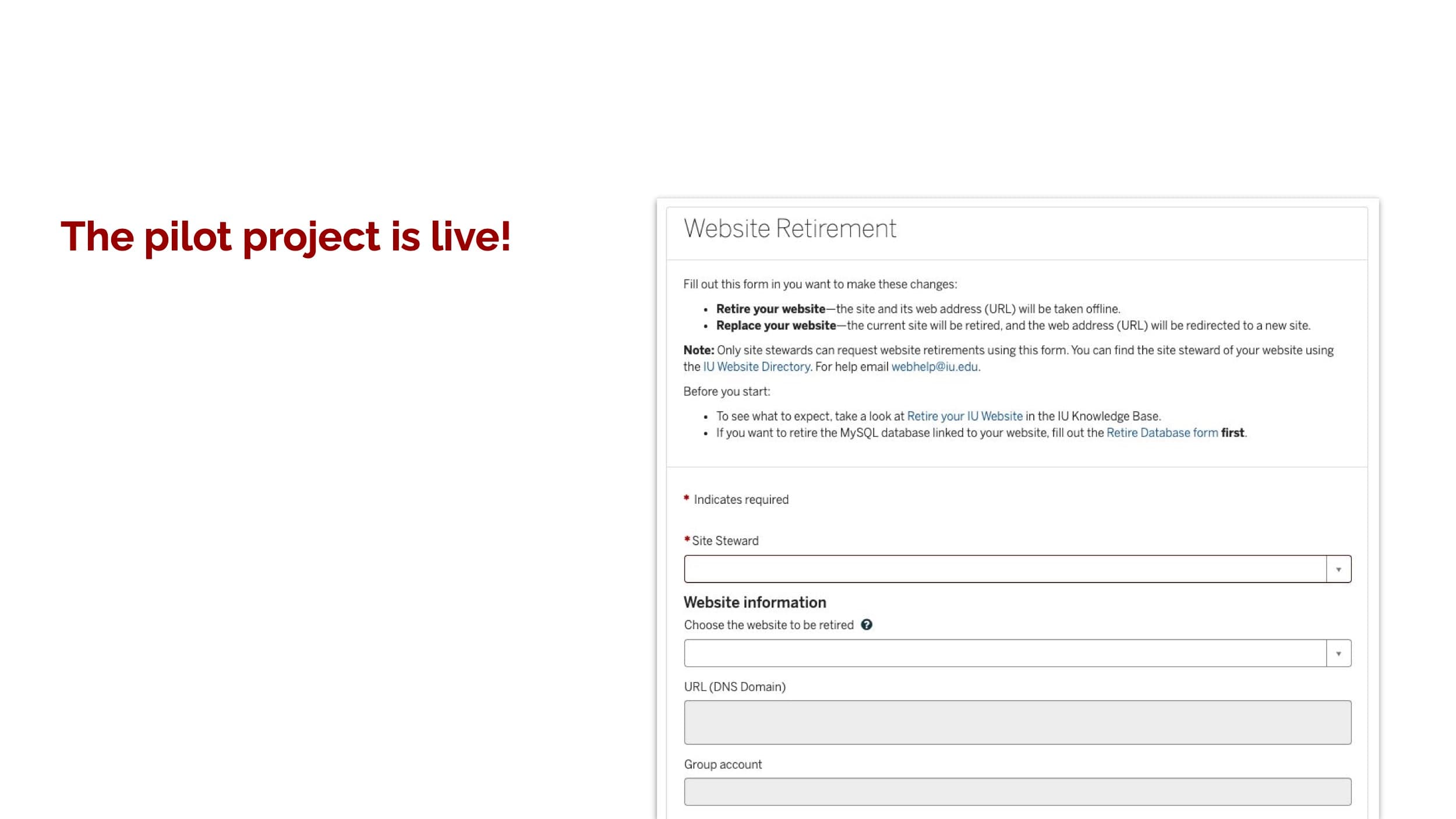
Seven steps became two — a 71% cut that IU's teams now run launches on.
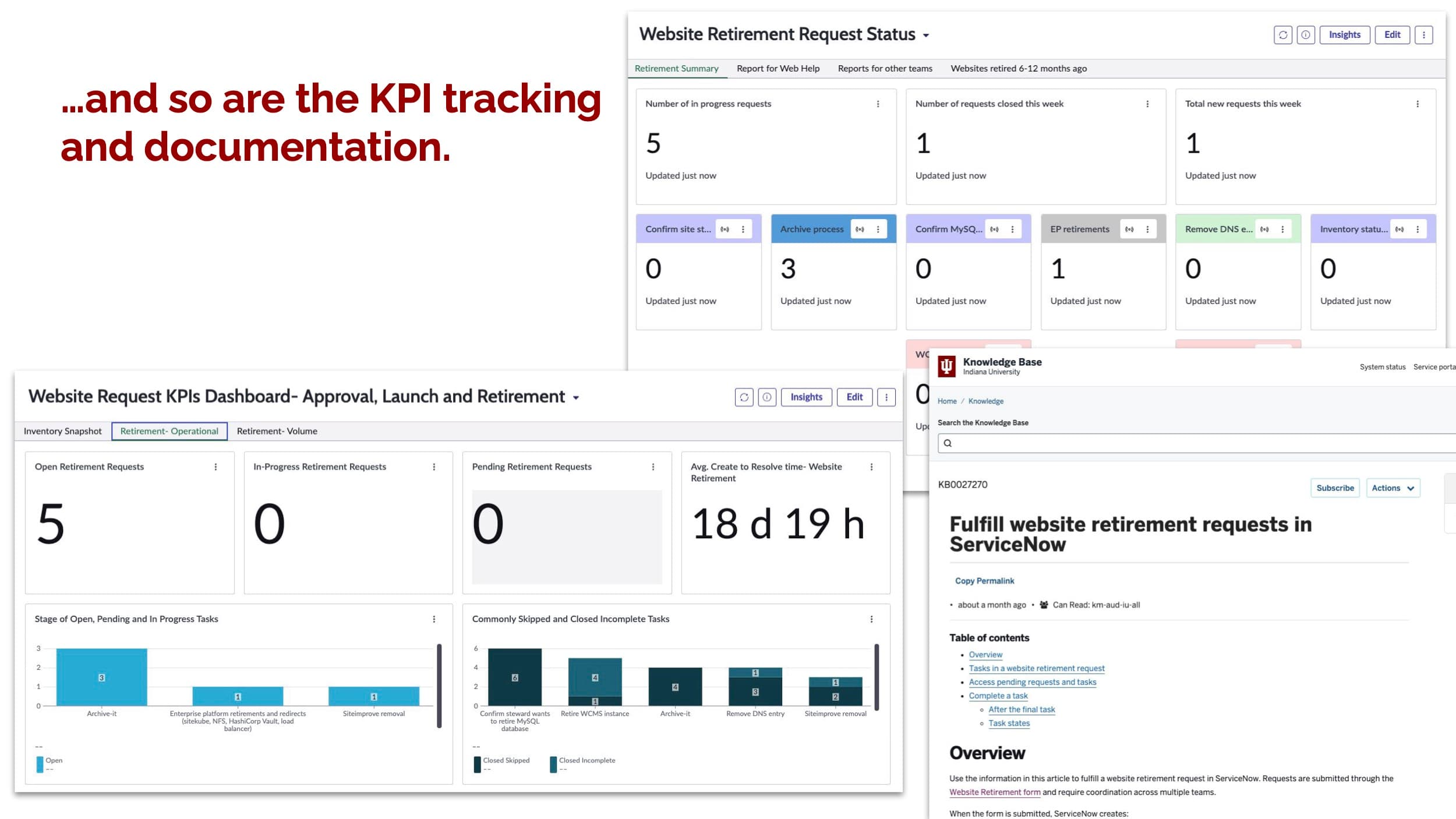
The workflow went from 7 steps to 2, a 71% improvement in process efficiency, now used by the teams managing IU's web properties — a requester touches the process once to request infrastructure and once to go live, with retirement now handled inside IT rather than by the requester at all. The same redesign helped clear a backlog of 1,500+ outdated sites that the old email-only retirement process could never keep up with. A KPI dashboard now tracks retirements and turnaround time, already down 25% this early in the rollout.
Next time, I'd lead with more conviction, earlier, on influence rather than research alone.
This project involved robust, established teams with their own workflows and senior stakeholders. Coming in at a junior level, I'd lead with more confidence earlier, and focus sooner on learning how to influence — not just show up as a researcher and outsider. This was internal work; getting existing teams to commit to a new process, and to trust a tool they'd underused for years, took more than good research — it took a good handle on influence.
Where this leaves things
“The thread running through it: a legacy process only breaks when the people who own it help rebuild it — that's the principle I carry into every workflow I touch.”